Vehicles capable of going off-road are big business. The global off-road vehicle market is currently valued at $24.33 billion and could surpass $36 billion by 2031. There are many ways to equip a vehicle to step off the pavement, ranging from factory-trail-ready trucks and SUVs to aftermarket modifications.
Yet by some estimates, as few as 10-15% of people who own an off-road-capable vehicle regularly take it off-road. And even among that crowd, there is intense debate over what modifications are useful and which are for show. Knowing what features you’ll realistically use will streamline your shopping experience.
To that end, I’ve taken 19 of the most popular off-road features and broken them into three categories: features for high-level trails, features for poor weather or mild off-roading, and features you should look right past.
Features That Help You on the Trails
Serious off-roaders don’t add components willy-nilly. Doing so would quickly drain their budget and leave them with more show than go. Focus on these features that have been proven in extreme situations.
- Mud-Terrain Tires: If you’re primarily driving on mud, snow, grass, and rocks, you need tires designed to grip these surfaces. Mud-terrain (a.k.a. maximum-terrain) tires have aggressive tread patterns and reinforced sidewalls to drive on unmaintained paths. They won’t do well on smooth pavement, but that’s not what you’re buying them for.
- Four-Wheel Drive: There’s no substitute for true 4×4, which sends equal power to the front and rear axles. This helps maximize traction and torque on uneven or slippery terrain. Some modern 4×4 systems automatically engage when needed, but manual or full-time 4×4 works just fine, too.
- Suspension Damping and Travel: When you’re constantly changing terrain, your suspension needs to be up to the task. Shocks and springs tuned for extra damping will absorb harsh bumps and impacts. Using a mid-travel or long-travel suspension can provide more articulation and forgiveness.
- Underbody Protection: Commonly found in the form of skid plates, this armor provides a barrier against stumps, rocks, debris, and anything else that could otherwise tear up crucial mechanical components. Potential locations for skid plates include beneath the engine, transmission, transfer case, driveshaft, and fuel tank.
- High Approach, Breakover, and Departure Angles: These refer to the angles between the tires and the lowest points of the front bumper, midsection, and rear bumper. Steeper angles help you get over objects and sharp hill crests. Factors such as tire size, ride height, and spare tire location affect these angles.
- Two-Speed Transfer Case: When you’re climbing steep hills or tiptoeing over rocks at slow speeds, sometimes standard gear ratios don’t produce enough torque. A two-speed transfer case will provide extra pull for crawling, overlanding, towing, and more.
- Locking Differential: Even when 4WD is engaged, a single wheel can lose traction with an open differential, leaving you stuck. Serious off-roaders use a differential that locks the rear axle as needed so both wheels spin evenly. This can be mechanical, electronic, or automatic. Some may even benefit from a front locker.
Features for Bad Weather and Moderate Terrain
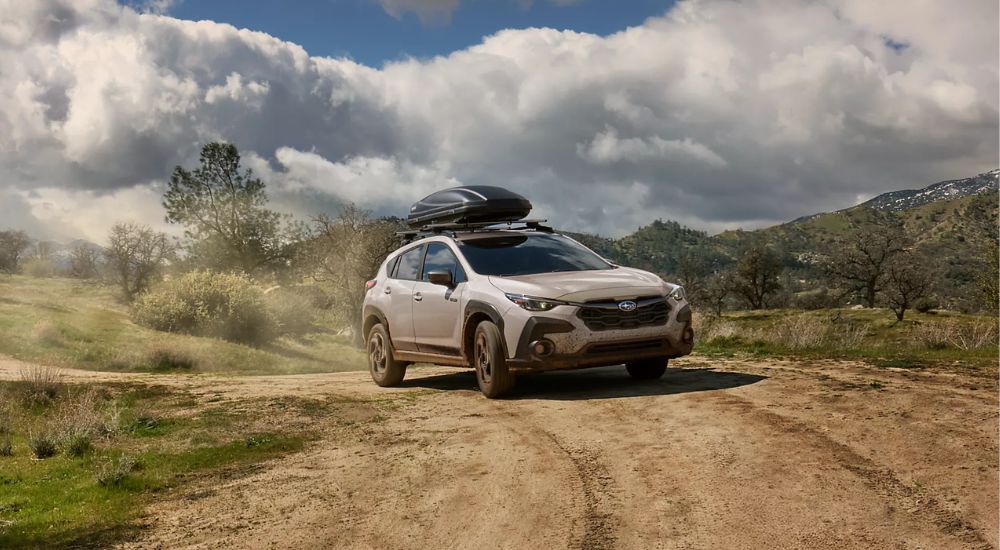
Many enthusiasts fall into the “off-roading lite” category and should seek features to handle more casual exploring and foul-weather driving. They may provide benefits for challenging off-roading, but mostly have advantages on the pavement.
- All-Wheel Drive: In an AWD system, torque distribution automatically adjusts based on wheel-speed feedback, rather than sending equal power to each axle at all times, as in 4WD. Such a system provides a more comfortable and fuel-efficient experience on dry and wet pavement, dirt roads, and mild trails.
- All-Terrain Tires: As a happy medium between mud-terrain and all-season tires, all-terrain tires improve traction for snow, rain, and dirt while still providing reasonably good on-road ride quality. They also last longer and cost less than mud-terrain tires, making them a good pick for winter driving and entry-level adventuring.
- Moderate Ground Clearance: You don’t need a foot of chassis clearance for mid-level off-roading. In most cases, 8-9 inches is sufficient to clear obstacles. That same clearance also comes in handy after several inches of snowfall or if there is large debris in the road.
- Intelligent Traction Management: These systems, which are often known as selectable drive modes, go beyond standard traction control to fine-tune torque, shift points, and more. If your vehicle has modes such as “Snow,” “Mud,” and “Sand,” you have a great set of tools to maintain grip.
- Fog Lights: A set of these special auxiliary lights will improve visibility by reducing glare in fog, heavy rain, snow, dust, and other conditions. White lights are good for lighter fog and precipitation. Yellow or amber lights produce better results with less eyestrain in severe weather.
- Limited-Slip Differential: This type of differential reduces slip between the rear wheels in low-traction situations without eliminating it entirely. When paired with your drive modes, an LSD is usually enough for moderate off-roaders who need more traction for green-laning and other endeavors.
Features That Are a Waste of Time and Money
Some off-road components sound cool and might be useful for specific activities. In most cases, though, off-road vehicle owners will encounter those scenarios, making them something not worth considering.
- Oversized Tires: While larger tires can offer benefits such as ground clearance and traction, those come at a significant cost. The added weight increases suspension strain and stopping distances while reducing fuel mileage. Oversized tires also raise the effective gear ratio, forcing you to buy other parts to compensate.
- Side Rails: Along with side steps and running boards, these are convenient for passengers, but that’s about it. Unlike true rock sliders, side rails aren’t designed to withstand hard impacts, so they buckle, break, or cave in easily. They can damage body panels in the process, meaning even more expensive repairs.
- Light Bars: An extra light here or there is fine, but giant light bars mounted on the roof are excessive at best. At worst, they cause backscatter and glare that actually hurt visibility. Beyond that, light bars aren’t legal for street use, hurt aerodynamics, cause loud wind noise, and don’t work well at high speeds.
- Brush Guards and Bull Bars: Ostensibly, these parts are to protect your radiator. In reality, most aren’t strong enough to withstand even a mild impact. Others transfer those impacts to the frame, worsening the damage. They can also interfere with cooling, camera systems, and driver assistance sensors.
- Rear Ladders: Unless you have a roof-mounted tent or frequently use your roof rack system, permanent ladders aren’t worth the drawbacks. They interfere with tailgate access, hurt the departure angle, are prone to corrosion, and create water intrusion points. You’re better off with a separate stepladder.
- Snorkels: These special air intakes are great for competition engines to reduce water and dust in the engine, but are unnecessary for the average off-roader, who will do fine with a high-quality air filter. Furthermore, installing a snorkel causes irreversible damage to your body, since you need to cut a hole in your bodywork. It might even void the vehicle’s warranty.
Drive Off-Road Smarter
An off-roading aesthetic and an off-road vehicle are two separate things. A feature might sound and look cool, but if it’s not going to measurably help performance in your unique driving lifestyle — or worse, cause unforeseen issues — then it’s not worth the investment.
The key is being self-aware enough to know how you really use your vehicle. Once you recognize whether you’re an advanced off-roader, a casual off-roader, or just a foul-weather driver, you can pursue the OEM and aftermarket features that you will actually use. The result is better performance without going past your budget.