
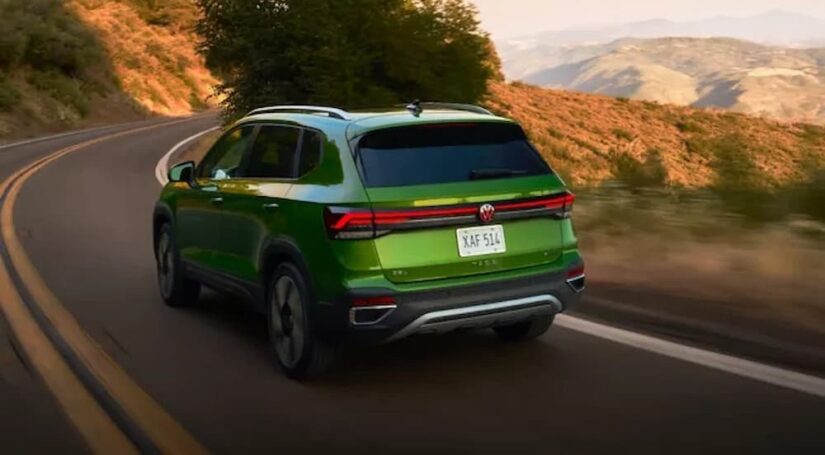
From its distinctive modern styling and punchy turbocharged engine to its premium design and available 4MOTION all-wheel drive system, there are plenty of reasons to love the new 2026 Volkswagen Taos.
VW’s smallest crossover serves as a satisfying substitute for the iconic Golf, which departed the lineup in 2021. It might lack the zippy potential of the dearly departed hatchback, but the Taos fills a similar role, allowing drivers to enjoy VW’s penchant for performance-focused design and refined styling without breaking the bank.
The Taos is notable for its generous dimensions and routinely outclasses the rest of the subcompact segment in both passenger and cargo space. The SUV was graced with a thorough refresh for the 2025 model year, and the results speak for themself as the new, more powerful, and more technologically advanced Taos set a new bar in the subcompact segment.
Let’s explore the details of the recent refresh, see how the SUV stacks up against the rest of the subcompact class, and learn why there’s never been a better time to seek out a Volkswagen Taos for sale.
Improving With Age
The Taos only hit the market in 2022, but time passes quickly in today’s ultra-competitive crossover segment. In an effort to keep the SUV relevant in a quickly changing market, VW treated the Taos to a proactive refresh for the 2025 model year.
The brand went back to the drawing board to equip the subcompact model with a bold new exterior design that’s sure to turn some heads as you drive around town. The updated front end takes some inspiration from the brand’s EV lineup, specifically the ID.4, with VW dramatically downsizing the grille and framing it with LED light bars. A set of connected LED taillights brings a similar aesthetic to the back end and proves that VW has been keeping a finger on the pulse of recent automotive trends.
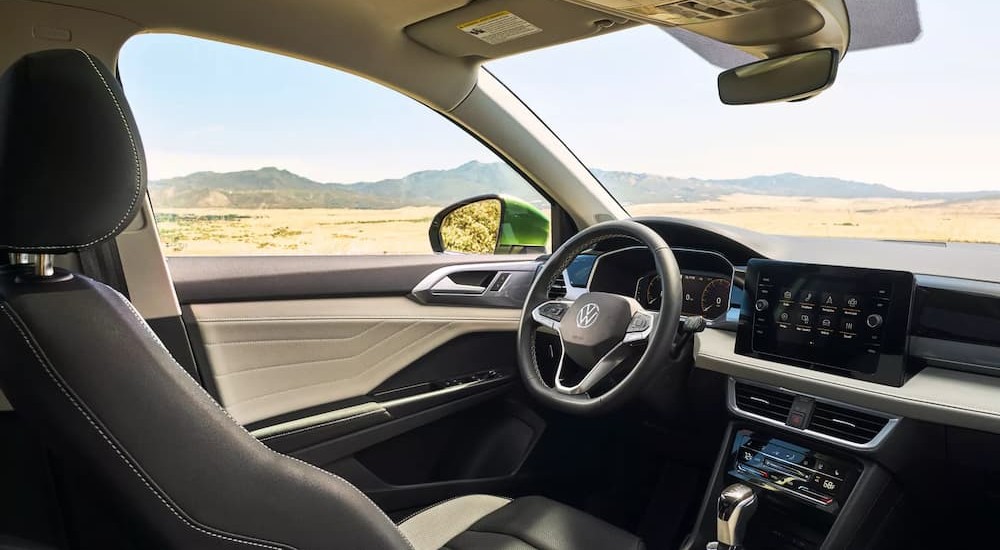
The Taos also gained an updated interior that includes a standard eight-inch touchscreen display, an AI-powered virtual assistant, a standard digital instrument cluster, and a redesigned steering wheel complete with new built-in controls. The automaker’s semi-automated Travel Assist driving assistance system also entered the fray for 2025, providing drivers with a new level of convenience that’s sure to come in handy on longer journeys and well-worn routes.
While these interior upgrades and styling changes are sure to up the Taos’s appeal, it’s the SUV’s improved engine that really caught our attention this time around. The new model is equipped with the same 1.5-liter turbocharged inline-four that’s been powering the crossover since its inception, but the automotive wizards over at VW have managed to up the output by almost 20 hp.
A Refreshing Take On Performance
Pure performance isn’t usually the main attraction when it comes to the subcompact crossover segment, but the Taos is able to deliver a well-rounded ride that provides a perfect balance between power and efficiency.
Much of the credit goes to the new 1.5-liter engine, which delivers 174 hp and allows the SUV to outclass many of its subcompact rivals. The previous 158 hp design already gave the Taos an advantage over much of the segment. However, those extra 16 ponies further improve the crossover’s appeal, leaving competitors like the Nissan Kicks (141 hp), Buick Encore GX (155 hp), and Honda HR-V (158 hp) in the dust.
While the Taos was previously outfitted with a seven-speed dual-clutch transmission in all-wheel drive models, it now routes its power through the same eight-speed automatic transmission as the front-wheel drive model. The all-wheel drive setup does noticeably enhance the SUV’s off-road ability. Though its crossover design and subcompact size prevent it from running too wild, the added traction and stability are sure to come in handy when tough winter weather hits.
The other key difference between the front-wheel drive and all-wheel drive versions of the Taos comes down to the rear suspension. The basic setup is built around a torsion beam design, but the all-wheel drive version leverages a multilink approach that delivers improved handling and comfort by more effectively controlling wheel movement and reducing body roll.
Most importantly, however, neither version relies on a continuously variable transmission (CVT). While a CVT certainly has its advantages in terms of overall efficiency, the lack of set gears can create a strange sort of buffer between the driver and the vehicle. By opting for a traditional automatic, the Taos provides drivers with a more engaging, responsive experience that goes a long way towards creating a solid connection between man and machine while still delivering some of the best fuel economy in its class.
An EPA-estimated 28 MPG in the city and 36 MPG on the highway gives the 2026 Taos a rating of 31 MPG combined, making it one of the most efficient non-hybrid subcompact crossovers on the market today. For comparison, the Chevy Trax barely breaks the 30 MPG combined mark, while the Honda HR-V and Mazda CX-30 log a relatively thirsty 28 MPG combined and 27 MPG combined, respectively.
Subcompact In Name Only
The 2026 Taos defies its subcompact designation to provide drivers with one of the segment’s roomiest options. While most of the segment offers a five-passenger setup, the ability to comfortably seat all five riders is a different story altogether. Other options might leave passengers feeling a little too cramped, but VW has designed the Taos with some generous dimensions that’ll provide plenty of room for the whole family.
It all starts in the first row, where the driver and front-seat passenger will enjoy 40.7 inches of headroom. The lofty interior means that even taller drivers will feel right at home in the 2026 Taos, which is more than can be said for some of the crossover’s competition. The Hyundai Kona and Nissan Kicks don’t trend too far behind the VW, with 39.9 and 39.7 inches of first-row headroom, but if you have any budding NBA players in the family, options like the Mazda CX-30 might feel a bit cramped at 38.1 inches.
It’s pretty much the same story when you slide into the second row, where Taos owners will enjoy 39.8 inches of rear headroom, but it’s the difference in legroom that really elevates the Taos above much of the subcompact class. VW has designed the Taos with 37.9 inches of second-row legroom, which is a pretty stunning figure in a smaller model.
The Hyundai Kona gives the VW some stiff competition, but the rest of the segment fails to keep pace. The Mazda CX-30’s backseat is going to be a tough sell for full-grown passengers with 36.3 inches of legroom, and you’ll have to be an Olympic-level contortionist if you want to find any comfort in the Nissan Kicks, as it maxes out at 34.5 inches.
Room for All of Your Cargo
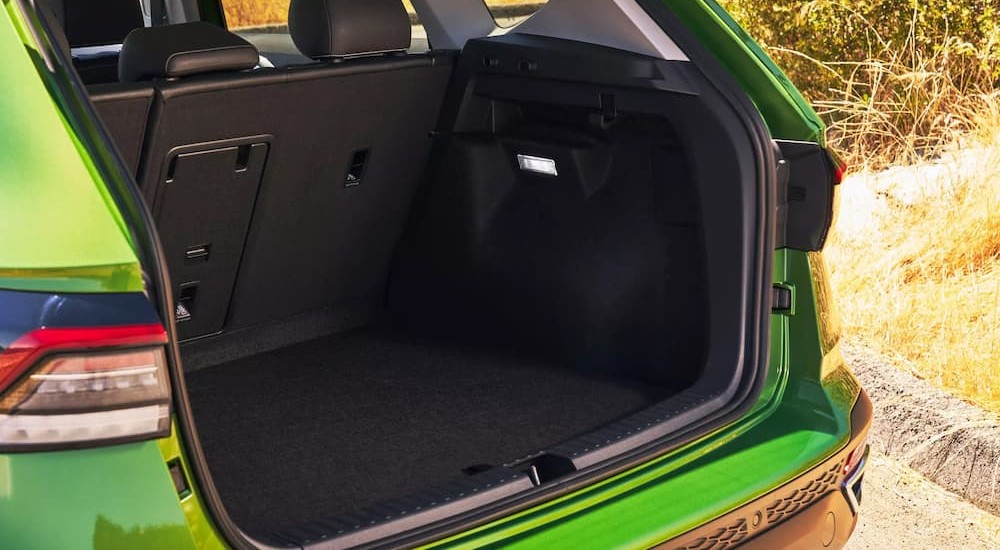
The Taos’ roomy interior isn’t just focused on passenger comfort. The crossover also provides some of the best cargo space in its class with the VW offering 27.9 cu.ft. of storage when both rows are occupied. The Honda HR-V simply can’t compete at 24.4 cu.ft., but it still fares better than some of the segment’s more diminutive models like the Mazda CX-30 (20.2 cu.ft.) and the Subaru Crosstrek (19.9 cu.ft.).
If you need to accommodate larger freight, luggage, or crucial outdoor equipment, simply fold down the second row and the Taos more than doubles its total capacity to 65.9 cu.ft. Again, the competition from Honda, Mazda, Subaru, and Chevy opponents is put firmly in the rearview mirror, with only the Hyundai Kona managing to come within 3 cu.ft. of the spacious VW.
Upgraded Tech Features
The 2026 Volkswagen Taos might lead much of the subcompact segment in terms of power, efficiency, and interior space, but these features hardly scratch the surface of the SUV’s appeal.
The Taos’s new standard eight-inch touchscreen infotainment display employs a unique, floating design that ups the SUV’s ergonomic appeal, and can be used to leverage the full power of your smartphone thanks to Apple CarPlay and Android Auto connectivity. Premium features range from a panoramic sunroof and ventilated front seats to an ambient interior lighting system and an auto-dimming rearview mirror that’ll help to reduce the glare from tailgating motorists.
The Taos also puts safety front and center with a comprehensive array of advanced driver-assistance systems (ADAS) that includes both the standard fare—such as forward-collision warning, lane keeping assistance, and adaptive cruise control—as well as premium features that speak to VW’s upscale approach. The optional parking sensors are certainly helpful, but Emergency Assist probably represents the SUV’s most cutting-edge feature. If it detects the driver is unresponsive, it will activate the hazards and safely pull to the shoulder.
Another Winner From VW
Drivers have plenty of options to choose from when they’re in the market for a subcompact SUV. But if premium details, efficiency, interior space, and cargo capacity top your list of must-have features, there’s no reason to bounce between dealerships with the 2026 Volkswagen Taos on the scene. By marrying Volkswagen’s signature driving dynamics with segment-leading utility and a sophisticated tech suite, the Taos transitions from a mere entry-level crossover to a top-tier contender for any lifestyle.