
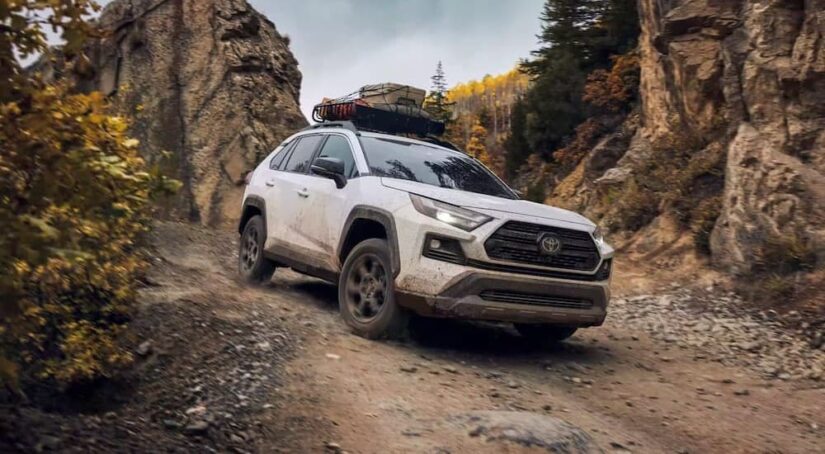
Once a novelty limited to certain luxury and performance vehicles, all-wheel drive (AWD) is now prevalent throughout the automotive landscape. The U.S. Department of Energy estimates that, as of 2022, nearly 60% of all new U.S. vehicles sold have AWD or four-wheel drive (4WD). Although the exact numbers for the all-wheel variant aren’t available, it’s especially common on crossover SUVs and sedans to give them better traction when the going gets tough.
It’s easy to assume that, because AWD is so popular and widespread, it’s something you should get on your car. But is it necessary? This guide examines how AWD works, its advantages and disadvantages, and the situations in which it can enhance performance and safety.
What Is AWD?
Plenty of automakers tout their “intelligent” and advanced AWD, but all systems work the same basic way at the core. They consist of a front, center, and rear differential, which distribute power to the axles or individual wheels. On-board sensors monitor the wheel rotations for signs of slipping, wheelspin, or other loss of traction. If such a loss is detected, the engine control unit automatically reduces the amount of power and torque going to those wheels, instead redirecting it to the wheels with more traction, allowing the vehicle to maintain grip.
There are two main types of AWD systems: full-time and part-time. A full-time AWD setup always sends some power to each wheel, although it is not evenly distributed in regular driving conditions. It’s typically a ratio between 65/35 and 75/25. With part-time AWD, all torque is normally delivered to one axle, making the vehicle a 2WD car in most situations. Power is only sent to the other axle if there is a loss of traction. In both cases, the adjustments happen automatically with no driver input necessary. However, drivers can sometimes activate driving modes that alter the parameters, such as those designed for driving on snow or loose terrain.

AWD vs. 4WD
Some people use AWD and 4WD interchangeably, but there are distinct and important differences between them. For starters, 4WD always engages both axles equally, unlike the on-the-fly adjustments seen in AWD systems. The center differential is replaced with a transfer case, which maintains a 50/50 power distribution to the front and rear at all times. A transfer case sometimes provides a low-range gear ratio, offering improved torque and control, which is particularly useful in off-road situations. A 4WD system also must be manually turned on and off by the driver, whereas AWD activates automatically.
Another key difference is the primary drive wheels when 4WD/AWD isn’t engaged. Most 4WD setups are based on rear-wheel drive vehicles. Conversely, in AWD cars, the front wheels tend to be the primary drive wheels for fuel efficiency purposes (those systems aimed at performance enthusiasts are usually rear-wheel biased). As such, 4WD and AWD cars have unique handling characteristics when they’re not redistributing the engine torque.
Pros and Cons of AWD
Now that you know the basics of how it functions, it’s time to look at the upsides and downsides. AWD can do a lot of good things for the average driver, but there are a few drawbacks to be aware of as well.
The Good of AWD
An AWD system can significantly enhance grip on roads that are slippery due to rain, snow, ice, slush, or dirt. You’ll be able to accelerate and cruise more smoothly and safely with no driver input necessary. AWD can also help with performance in dry conditions. Notably, you can accelerate out of turns faster with AWD because the tires are less likely to spin. The effect is amplified if the vehicle also features torque vectoring, which allows power to be distributed between the individual drive wheels.
AWD tends to cost less than 4WD, making it more budget-friendly if you don’t need the extreme capabilities that 4WD provides. AWD also works much better than 4WD on dry roads, since the automatic torque adjustments eliminate wheel skipping and hopping in corners. A car with AWD tends to have better resale value than a 4WD or 2WD car, especially in areas where AWD is in high demand. Since each automaker’s system has different points of emphasis, you can find one that best fits your needs.
The Bad of AWD
Although AWD helps with acceleration on slippery roads, it doesn’t affect stopping or turning. (That’s what traction control and anti-lock brakes are for.) As such, outlets have reported drivers experiencing a “false sense of security” about how much grip they have and thus driving recklessly. Because AWD is reactive and rarely achieves equal power distribution between wheels, it is significantly less effective than 4WD in severe conditions, such as heavy snow and deep mud.
An AWD vehicle will cost more upfront than a 2WD vehicle, and the increased complexity means more potential failure points, which can further increase maintenance and repair costs, such as changing the fluid in multiple differentials. AWD cars often have worse fuel mileage than 2WD cars due to the extra components, which add weight and leech engine power. You also need to rotate the tires more often since uneven wear can affect torque distribution. In some cases, AWD vehicles have slightly smaller cabins than 2WD machines, as the necessary powertrain components, such as a center differential and a rear driveshaft, occupy more space.

Which Drivers Will Benefit from AWD?
Now that we’ve gone over the cold, hard facts of AWD, it’s time to look at who gets the most from this system. The primary factors that should influence your decision are the local climate and the roads you use most frequently.
If you primarily drive on paved roads and inclement weather mainly consists of rain and light snow, a 2WD setup (FWD or RWD) will be fine. If you experience heavy rain and moderate snow more frequently, AWD is a good choice. Likewise, AWD is usually adequate for adventurers who stick to light-duty off-road trails and unmaintained roads. When it comes to performance vehicles, AWD can provide a boost on roads and tracks with a lot of corners, although some people still prefer the dynamics of RWD. Those who encounter a lot of heavy snow and mud, or want to do more serious off-roading, are better off with 4WD.
The drive wheel layout is only one of the many factors that affect your vehicle’s grip in various situations. Beyond AWD vs 4WD vs 2WD, you’ll also need to look at tires (tread type, compound softness, air pressure, wear, etc.), what the suspension components are designed for and how worn they are, how good the brakes are, and how much cargo you are carrying.
Choosing the Right Type of Drive
The best way to describe AWD is that it’s an ideal “in-between” system. It’s a great system for someone who doesn’t drive on perfect roads most of the time, but is unlikely to encounter or be affected by the most intense weather, such as in the Midwest, Northeast, and Pacific Northwest. AWD also has some advantages for performance driving, although that may depend on personal preference and whether the organizers permit it. That said, it’s not a foolproof system and shouldn’t be treated as such. Be aware of the potential limitations and how they may affect aspects such as fuel mileage and vehicle maintenance. What’s more, don’t neglect other performance factors and rely solely on AWD to bail you out.