When you drive a gasoline-powered vehicle, refueling is simple: drive up to the pump, put the nozzle in your tank, and hit the button. But EV charging is a little more complicated since not all EV charging stations are compatible with all EVs.
The charging situation is rapidly improving as the technology matures, but there is still a bit of a learning curve for new EV owners to understand where they can and can’t recharge. If you’ve just bought your first EV (or are considering buying one), here’s what you need to know about the different types of charging ports, plugs, and adaptors.
Four Competing Standards
Gas stations all use the same type of nozzle, but that’s because we’ve had over 120 years to refine the process. In contrast, the first modern EV charging standard was only introduced in 2001, and the technology has changed dramatically over the past 25 years.
Today, you can find four different types of plugs at EV charging stations across the country, each representing a different generation of charging technology. The four standard plugs you can find today include:
- J1772
- CHAdeMO
- CCS
- NACS
We’ll get into all the differences in a moment, but for now, what you need to know is that J1772 and CCS are compatible standards for slow and fast charging that can be found on many current EV models and at charging stations across the country. However, they are being replaced by NACS, which is a more convenient standard that was developed by Tesla and uses a single plug for both slow and fast charging. CHAdeMO is an older fast-charging standard that is now almost entirely gone from the market.
If you’re shopping for an EV today, a model equipped with NACS will be the most future-proof. Still, there is plenty of J1772 and CCS infrastructure around the country, and models equipped with these ports can charge from NACS plugs with commonly available adaptors. So if you bought (or are considering) an EV with J1772 or CCS ports, don’t worry: you’ll have no trouble charging. However, you probably want to avoid anything with CHAdeMO.
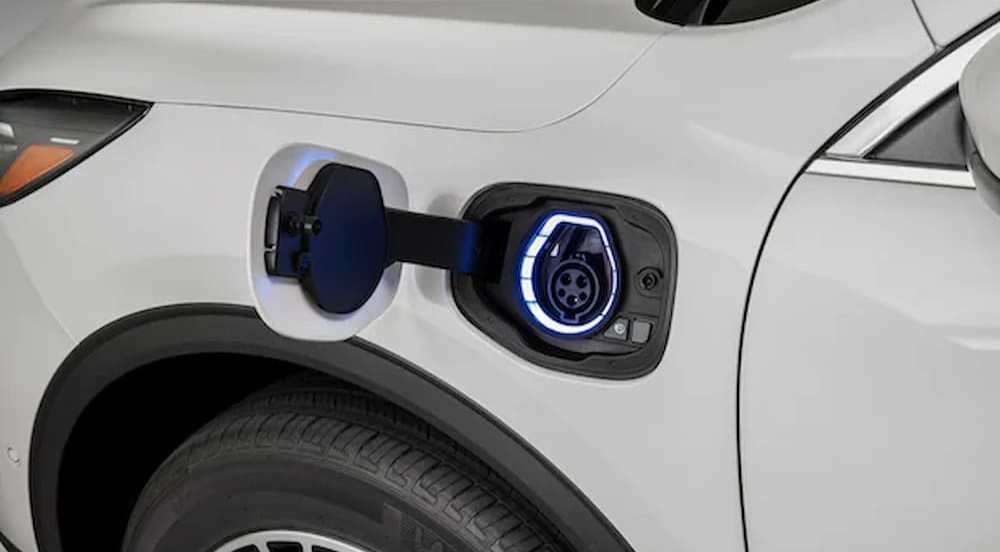
J1772
J1772 is the oldest EV charging standard on the market, and it’s also the most common plug type in use. It was originally designed in 2001 by the California Air Resources Board to replace the older J1773 “Magne Charge” standard used by early models like the GM EV1. However, the original rectangular J1772 plug was redesigned in 2008 and replaced with the current circular plug you will find in modern charging stations.
Unlike the other three plugs you will find, J1772 is only used for Level 1 and Level 2 AC slow-charging. This means its use is mostly restricted to home charging stations, although there are some Level 2 (and even Level 1) public “destination chargers” where you can plug in at your destination (such as a mall or hotel) and get a bit of a charge while you do whatever activity you went there to do.
Because J1772 is only used for slow charging, it is only found by itself on plug-in hybrid (PHEV) models. Modern battery-electric vehicles (BEV) will always pair a J1772 port with one of the Level 3 DC fast-charging plugs so you can quickly recharge and keep traveling on longer road trips.
J1772 is fully compatible with NACS via an adaptor, whether you have a vehicle with a J1772 port trying to connect to a charging station with a NACS plug, or vice versa. However, because NACS is used for both slow and fast charging, you have to make sure that your J1772 vehicle is connected to a NACS slow-charging station. (If you accidentally connect to a NACS fast-charger, you won’t damage anything; the car simply won’t charge.)
CHAdeMO
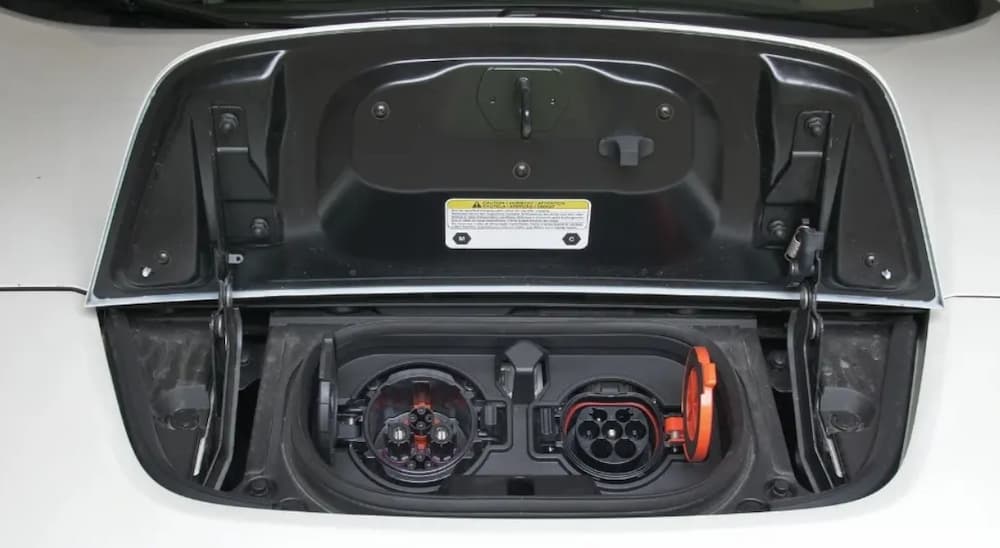
As EVs became more capable in the late 2000s, engineers began working on ways to recharge them more quickly so that long-distance trips could be possible. The first successful attempt at a Level 3 DC fast-charging standard was CHAdeMO, which was introduced in 2009.
This standard was developed by the Tokyo Electric Power Company in conjunction with Nissan, Mitsubishi, and Subaru. The name is actually an abbreviation of the Japanese phrase “ocha demo ikaga desuka” (“Would you care for some tea?”), alluding to how much time is needed to recharge.
Unlike more modern standards, CHAdeMO can only be used for DC fast-charging and requires a separate J1772 port for Level 1 and Level 2 AC slow-charging. Further, while the current CHAdeMO charging standard can support charging speeds of up to 400 kW, these plugs are mostly found on older charging stations that are limited to charging speeds of less than 100 kW.
These limitations mean that the CHAdeMO charging standard is effectively obsolete. For the 2026 model year, there is only a single model that uses it: the Mitsubishi Outlander PHEV. If you are shopping for a pre-owned EV, then the main CHAdeMO model you will find is the Nissan LEAF, although it switched to NACS as part of its 2026 redesign.
While adaptors exist that allow CHAdeMO vehicles to use CCS and NACS chargers, these adaptors are fairly rare and expensive because the limited range and charging speeds of most CHAdeMO models mean they are rarely used for long trips where fast-charging is necessary.
CCS
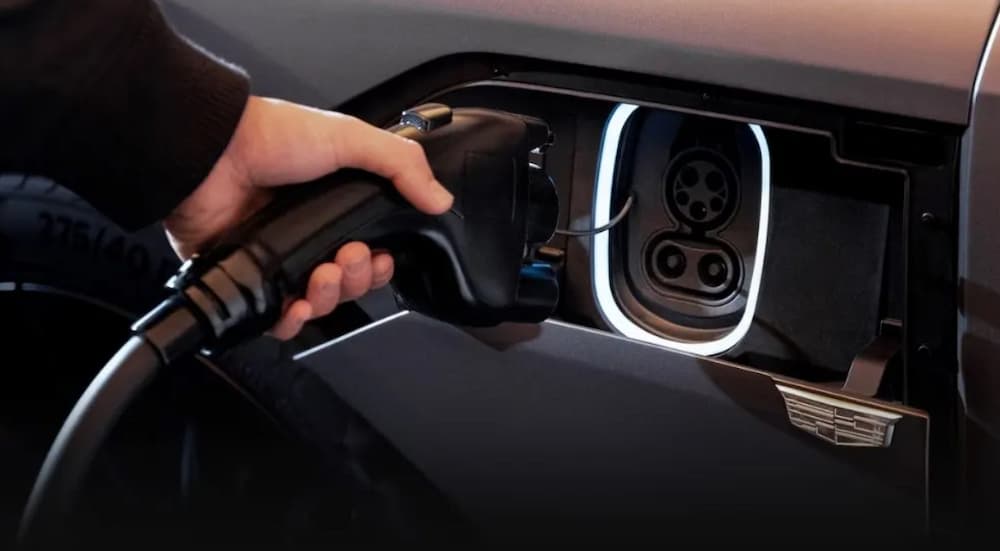
Having two separate charging ports for Level 3 DC fast-charging and Level 1 and Level 2 AC slow-charging was obviously not the most elegant solution, so in 2011, the Association of German Engineers introduced CCS, the “Combined Charging System.” There are technically two different versions of CCS (Type 1 for America and Type 2 for Europe), but this is not a concern for shoppers, given that all American-market vehicles and chargers use the same standard.
CCS Type 1 stacks a J1772 plug on top of two larger pins that allow it to be used for Level 3 DC fast-charging. This unique configuration means that EVs designed for this standard allow you to uncover just the top of the charging port to attach a J1772 plug, or uncover the entire charging port to attach the full CCS plug.
When it was introduced, nearly every manufacturer standardized on CCS, with the only real exceptions being Nissan sticking with CHAdeMO and Tesla developing its own proprietary charging standard, NACS. This means there are plenty of CCS models on the market and an extensive CCS charging network (in addition to the J1772 chargers that CCS is also compatible with). Plus, NACS-to-CCS adaptors are readily available, with many manufacturers including them with all new vehicles they sell.
NACS
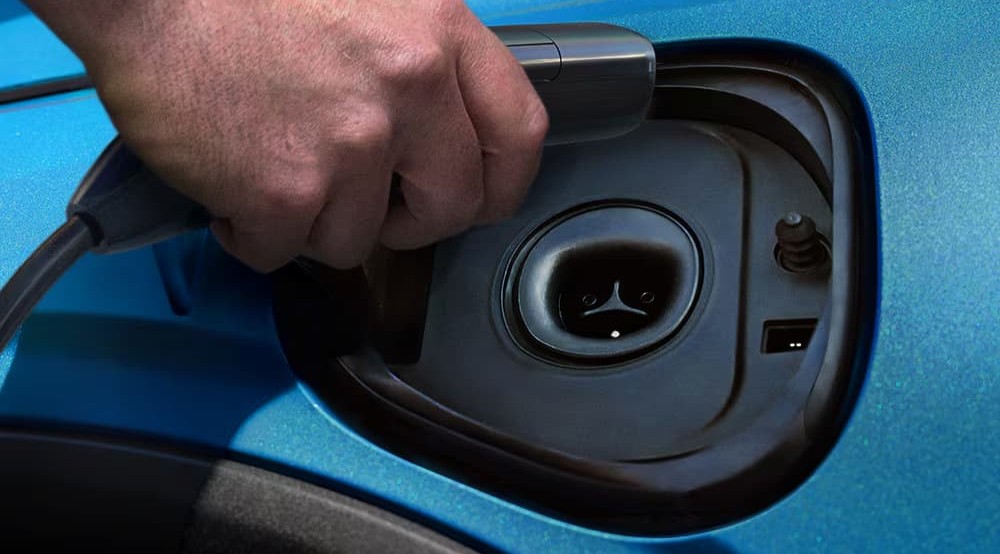
While most of the industry jumped on the CCS standard, the most important EV manufacturer did not. This was because Tesla already understood the limitations of the existing charging standards when it began developing its first ground-up EV in 2007. Thus, when the Model S debuted in 2012, it introduced a brand-new charging standard that seamlessly combined Level 3 DC fast-charging with Level 1 and Level 2 AC slow-charging into a single compact plug.
Also, unlike the other manufacturers, Tesla didn’t just design a new charging standard; it also began constructing a nationwide network of public charging stations to support it, installing the first Tesla Supercharger in 2012. While other EV manufacturers relied on third-party charging networks that grew slowly because of limited demand, Tesla invested heavily in the Supercharger network and was operating nearly 5,000 Supercharger stations a decade later in 2022.
In late 2023, Ford CEO Jim Farley took his brand’s new electric truck (equipped with CCS) on a cross-country road trip and was shocked at the poor state of the national CCS charging infrastructure. When he got back, he negotiated an agreement to give Ford access to the superior Tesla Supercharger network, and other car manufacturers quickly followed his lead.
Faced with a surge of interest in its proprietary charging standard, Tesla renamed its charging port design the North American Charging Standard (NACS) and made it publically available. Today, just about every manufacturer either provides NACS-to-CCS adaptors with its vehicles or produces its models with NACS ports. Many third-party charging networks are also beginning to install charging stations with NACS plugs.
Overall, NACS is a much simpler solution than any previous charging standard. It even includes an optional payment system integrated with the charging port that allows your car to automatically pay for charging without you having to take out your credit card or use a phone app.
The only thing to be aware of is that NACS covers both fast and slow charging with the same plug. This means it is possible to accidentally plug into a slow-charger rather than a fast-charger and not get the charging times you expect. However, the difference in charging types is typically fairly obvious once you know what to look for, so this isn’t a significant problem.
Charging May Be Complex Now, But It’s Getting Easier
While new EV buyers may be put off by the complexity of different charging ports and plugs, the truth is things are simpler now than they have been in the past—and it’s only getting easier. Standardization on NACS is ramping up quickly: the first non-Tesla model to use NACS was the 2025 Hyundai IONIQ 5, and for the 2026 model year, there is already a score of models from a dozen different brands that come with NACS ports.
The release of NACS-to-CCS and CCS-to-NACS adaptors also means that EV drivers can now easily plug in at nearly any public charging station, no matter what type of charging port their vehicle is equipped with. Many brands now provide complimentary adaptors to EV buyers, and there are plenty of affordable third-party adaptors available to choose from.
While it will probably take a few more years for the industry to fully convert to NACS, it is now clear that there will be a single standard going forward, and future EV shoppers will no longer have to worry about incompatible plugs when stopping to recharge. In a hundred years, recharging will be as simple and routine for drivers as filling up with gasoline is today.